Salesforce Architecture, Data & AI· Web Application

Enterprise integration hub

A secure, reliable integration layer connecting Salesforce with the enterprise's other platforms through MuleSoft, REST APIs and Apex callouts. It is designed for dependable data exchange, clear data ownership, and error handling that keeps operations running.

  • Sector Enterprise integration
  • Client Enterprise organisation
  • Role Salesforce developer and integration contributor
Connectivity and transformation between Salesforce and external systems
MuleSoft
Failures surface instead of failing silently
Recoverable
Salesforce security controls define what each integration can access
Secure
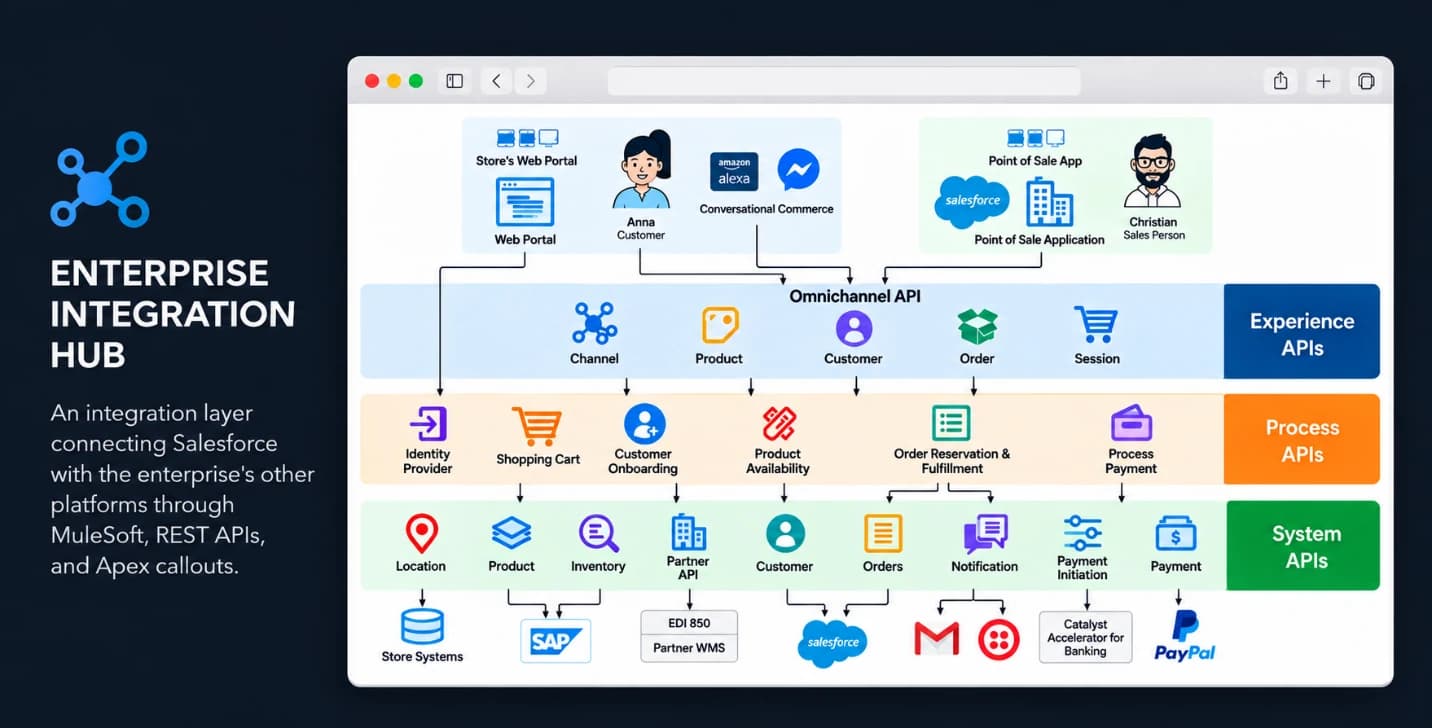
An API-led integration layer: experience, process and system APIs connecting a web portal, conversational commerce and a point-of-sale app to back-end platforms such as SAP, a partner WMS, Salesforce and PayPal
The starting point

The challenge

Critical data lived across multiple platforms. The architecture had to deliver reliable exchange and synchronisation, handle errors, stay secure and scale, all without disrupting operations already in flight.

The solution

What we built

  • Connectivity and transformation: MuleSoft and REST integrations between Salesforce and external systems.

  • Salesforce-side logic: Apex callouts and business-specific processing.

  • Data movement: transformation and migration using SOQL and Data Loader.

  • Synchronisation: ongoing sync with external systems.

  • Security: integrations operate under Salesforce security controls.

Architecture

How the system works

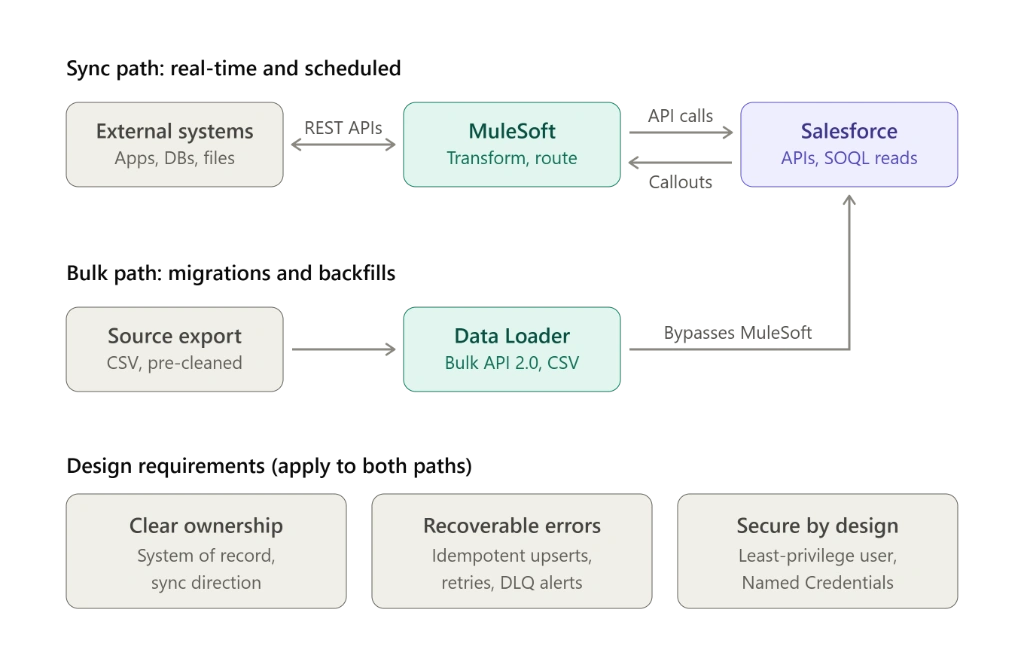
Integration architecture: real-time and scheduled sync path through MuleSoft, bulk migration path through Data Loader into Salesforce, governed by clear ownership, recoverable errors and security requirements
Real-time and scheduled sync via MuleSoft, bulk migrations via Data Loader, with clear ownership, recoverable errors and secure design across both paths.
Engineering

How it was engineered

  • Ownership before implementation. Each integration was evaluated on who owns the data, how closely systems must stay in sync, and which business processes depend on it, before anything was built.

  • A clear division of labour. MuleSoft and REST handle connectivity and transformation. Apex handles business logic on the Salesforce side. Each layer has one job.

  • Errors as a design requirement. Failures should be visible and recoverable rather than silent, so a bad payload doesn't become a data-quality problem or interrupt operations.

  • Security by design. Salesforce security controls define what each integration can access.

Scope

What was delivered

01

Controlled data exchange between CRM and enterprise platforms

02

Synchronisation with external systems

03

Migrated and transformed data

04

A documented integration approach

Technology

Stack

SalesforceMuleSoftREST APIsSalesforce APIsApex calloutsSOQLData Loader

Need something similar?

We can scope and build a system with comparable capabilities, shaped around your own workflows, data and integrations.